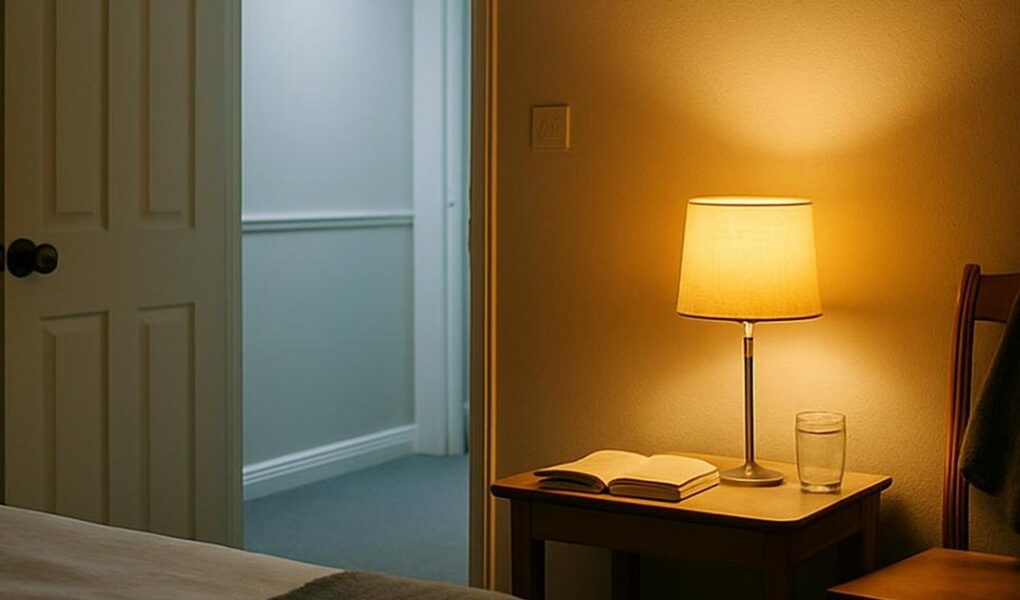
Warm white vs cool white for bedroom lighting is an easy call: warm white, 2700K on the box, every time. Kitchens can take cool white, 4000K, but only over the worktop. Halls sit in between at 2700K to 3000K. Those three rooms are where most people stand in the shop with a box in each hand, so here are the Kelvin numbers for each one, and for the rest of the house, so the box in your hand is the right one.
The words on the packaging are the problem. “Warm white” can mean 2700K from one maker and 3000K from another, and “natural”, “soft” and “bright” white mean nothing fixed at all. The Kelvin figure is printed on every box, usually on the back beside the lumens, and it’s the only thing to go by.
Kelvin in one minute
Colour temperature runs from orange at the low numbers to blue at the high ones. A candle is about 1800K. The old incandescent bulb most of us grew up with was about 2700K, which is why that number looks “normal”. Office lighting is usually 4000K. An overcast sky is around 6500K. The lighting industry sells home bulbs in a handful of bands:
| Kelvin | Sold as | Feels like |
|---|---|---|
| 2200K to 2500K | Extra warm, amber, vintage | Candlelight |
| 2700K | Warm white | A traditional bulb |
| 3000K | Warm white, soft white | Warm but a little crisper |
| 4000K | Cool white | Clean white, bluish next to a lamp |
| 5000K to 6500K | Daylight | Overcast sky; blue indoors at night |
Kelvin is colour only. Brightness is lumens, and cost to run is watts. A daylight bulb is not a brighter bulb; it’s a bluer one.
Bedrooms: warm white, or warmer
The bedroom is the one room where there’s no argument. 2700K for the ceiling light and the bedside lamps, and if you like the amber filament look, 2200K to 2500K at the bedside is even better for the last hour of the day. Cool white in a bedroom is the mistake people regret fastest, because it makes the room feel like somewhere you get ready rather than somewhere you rest. The one exception is a dressing table or a wardrobe mirror, where a separate 3000K or 4000K light on its own switch shows colour honestly for getting dressed.
If the bedroom has a multi-arm pendant, every arm needs the same bulb from the same pack. Five arms with bulbs bought at five different times will show five slightly different whites, and in a bedroom you’ll lie there looking at them.
Kitchens: warm for the room, cool for the worktop
This is the room where the rule splits. The kitchen is a place to work and a place to eat, often in the same square metre, and the general guidance the industry gives is 2700K to 3000K for the lights that fill the room and 3000K to 3500K for the lights that fall on the worktop. In practice that means ceiling spots or a pendant over the table at 2700K or 3000K, and a strip under the wall cupboards at 3500K or 4000K for chopping and reading labels. The cool light stays on the work surface, where it’s useful; the warm light does the rest, so the kitchen still feels like part of the house when the cooking’s done.
If the kitchen is open plan with the living room, keep every ceiling fitting at 2700K or 3000K and use brightness, not colour, to mark the working end.
Halls and landings: in between
The hall is the first room you see when you come in from a dark street and the colour of it sets the tone for everything behind it. 2700K to 3000K is right. 2700K if the hall opens straight into the living room, so the two match; 3000K if it’s a working space where you sort post and find keys. Whatever you choose, keep the landing the same as the hall, because you see both from the stairs. A hall fitted with a leftover cool white bulb makes every warm room off it look yellow.
The rest of the house
- Living room: 2700K throughout, lamps and ceiling light alike.
- Dining room: 2700K, dimmable, over the table.
- Bathroom: 3000K ceiling, 4000K at the mirror; each fitting rated for the zone it’s in.
- Home office: 3500K to 4000K at the desk, 2700K elsewhere.
- Utility room: 4000K, one bright fitting.
- Garage and workshop: daylight, 5000K and up.
- Porch and outside wall lights: 2700K to 3000K.
Warm white vs cool white: the short version
| Room | Ceiling or pendant | Lamps and task lights |
|---|---|---|
| Bedroom | 2700K | 2700K, or 2200K to 2500K at the bedside |
| Kitchen | 2700K to 3000K | 3500K to 4000K on the worktop only |
| Hall and landing | 2700K to 3000K | Same as the ceiling |
| Living room | 2700K | 2700K |
| Dining room | 2700K, dimmable | 2700K |
FAQ
Is warm white or cool white better for sleep?
Warm. Cooler, bluer light in the evening tends to feel more alerting, which is the opposite of what a bedroom is for. Keep the bedroom at 2700K or warmer and leave cool white for daytime rooms.
Can I put cool white in a kitchen pendant?
You can, but the table underneath will look like a canteen. Put the cool bulb in the under-cabinet light and keep the pendant warm, 2700K to 3000K, so the table is somewhere people want to sit.
Why do the bulbs in my multi-arm pendant look different colours?
They were bought at different times or from different packs. Even two “warm white” bulbs can be 2700K and 3000K. Replace the whole set together from one pack and the problem goes.
Do I need different bulbs for an easy fit pendant?
No. An easy fit pendant uses the same bulb holder as the fitting it replaces, so the cap size stays the same. Check the maximum wattage per arm on the product page and buy the same Kelvin for every arm.
Next step
Walk through the bedroom, the kitchen and the hall tonight and note any fitting that’s the wrong colour for its job; the hall and the kitchen ceiling are the usual ones. If the fitting itself is due a change, a multi-arm fitting from our easy fit pendants hooks onto the existing holder without an electrician and gives a bedroom or a hall a soft, spread light rather than one hard point, and the ceiling lights page has the larger piece for a dining room or a landing. Browse the whole range in the shop. Settle warm white vs cool white for the bedroom, the kitchen and the hall and every bulb after that is an easy buy.
