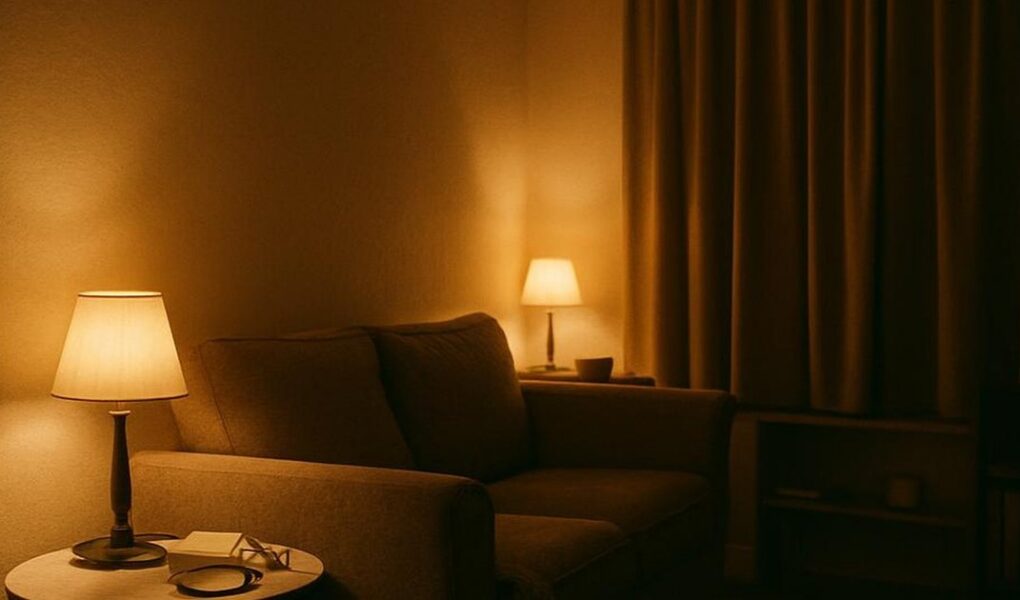
Lamps for dark evenings go in three places in a living room: one beside the sofa where you read, one in the corner you never light, and one low down at the far end of the room so the eye has somewhere to travel. Put them there, switch the ceiling light off, and the room stops being a lit middle with black edges and starts being somewhere you want to sit until bedtime.
After the clocks go back a living room lives on its lamps from about half past four. Most rooms have one or two lamps in the wrong place and a ceiling light doing a job it was never good at. This is where each lamp goes and why, what it stands on, and what to do with the pendant.
The corner you never light
Start here, not at the sofa, because this is the change people notice. Every living room has a corner that goes black after dark: behind the television, the far side of the chimney breast, the gap between the window and the door. A lamp there doesn’t need to be bright or clever. A small table lamp on a low table, or a lamp on a shelf at head height, is enough to stop the corner disappearing. Once the corner has light in it the room reads as its full size again, which is why people say the room feels bigger even though nothing has moved.
Keep this bulb soft, 250 to 470 lumens, and warm, 2700K. It’s background light, not reading light.
Beside the sofa
This is the working lamp. It goes at the end of the sofa, between the sofa and the armchair if there is one, so the light comes over your shoulder onto the page. A floor lamp does this without needing a table; a table lamp does it if there’s a side table of the right height at the sofa arm. The bulb here is the brightest in the room: 806 lumens, the figure most makers print as the old 60W equivalent, warm white and dimmable if you can.
A detail that gets missed: the light should come from the side, not from in front. A lamp on the coffee table shines in your eyes. A lamp at the arm of the sofa shines on your book.
The far end of the room
The third lamp balances the other two. It goes on whatever stands at the end of the room furthest from the sofa: a console table against the wall, a sideboard, a nest of tables by the armchair, the windowsill. It should be low, with the bottom of the shade at about the height of your eyes when you’re sitting down, so you see the glow and not the bulb. In a long room, this lamp at the far end makes the room look longer. In a square room, it fills the side nobody sits on.
The table matters as much as the lamp
A lamp is only ever as well placed as the surface it stands on, and this is where a lot of living rooms go wrong. A lamp on a tall bookcase lights the ceiling. A lamp on the floor behind the sofa lights the skirting board. The surfaces that put a lamp at the right height are side tables, console tables and nests of tables, and the rule of thumb is simple: the table top plus the lamp should put the bottom of the shade at seated eye level, roughly 100 to 110cm from the floor.
| Position | What the lamp stands on | Lamp height to aim for | Bulb |
|---|---|---|---|
| Beside the sofa | Side table at the sofa arm, or no table and a floor lamp | Table lamp 50 to 65cm on a table of about 50 to 60cm; floor lamp 150cm or more | 806 lumens, 2700K, dimmable |
| Dark corner | Low side table, nest of tables, or a shelf | Small lamp 30 to 45cm; doesn’t need to reach eye level | 250 to 470 lumens, 2700K |
| Far end of the room | Console table against the wall or a sideboard | Lamp 50 to 65cm on a console of about 75 to 80cm | 470 lumens, 2700K |
| Bay window | Small round table in the bay | Lamp 45 to 60cm, curtains drawn behind | 470 lumens, 2700K |
A console table is the piece most living rooms are missing. It’s shallow enough to go against a wall or behind a sofa, it gives the far-end lamp somewhere to stand at the right height, and it takes the post, the keys and the plant as well. A nest of tables does the same job in a smaller room and can be pulled apart when there are people round.
What to do with the pendant
The ceiling light doesn’t come down. It changes job. On an ordinary evening it’s off and the lamps do the work. When you need the whole room lit, for cleaning or a board game on the floor, it comes on, ideally through a dimmer. A multi-arm pendant with several small bulbs is the best version of this, because it spreads the light rather than dropping it from one point, and with a dimmable warm white bulb in every arm it can be turned down to a glow that works with the lamps instead of against them. Keep all its bulbs the same Kelvin as the lamps, 2700K, or the pendant will look a different colour from the rest of the room.
Tonight, with what you’ve got
- Ceiling light off. Sit down. Find the black corner.
- Move whatever lamp you own to the end of the sofa. Sit again.
- Borrow a bedside lamp for the corner, just to see.
- Look at the far end of the room and ask what the lamp would stand on. If the answer is nothing, that’s the missing piece.
- Check the bulbs: anything cool white or over 1,000 lumens in a lamp is on the swap list.
FAQ
How many lamps does a living room need?
Three for a room of ordinary size, two for a small one. More than four and you’re back to a bright room, which is what you were trying to get away from.
Where should a floor lamp go?
At the end of the sofa, between the sofa and the chair, or in the far corner of a long room. Never in front of the seating, where it’s in your eyes, and never behind a door.
What height should a side table be for a lamp?
About the height of the sofa arm, usually 50 to 60cm, so the lamp on it puts the shade at seated eye level. For a console against a wall, 75 to 80cm with a lamp of 50 to 65cm gives the same result.
Can I keep the pendant on as well?
Yes, dimmed. A multi-arm pendant turned right down adds a soft overall glow that lamps on their own can’t. On full it drowns them.
Next step
Work out the three positions first, then see what each one needs. If a lamp has nowhere to stand, our furniture range has console tables, side tables and nests of tables at the heights in the table above. If the ceiling light is a bare bulb or a single dated shade, a multi-arm fitting from our easy fit pendants hooks onto the existing holder without an electrician and dims down to sit alongside the lamps, and the ceiling lights page has the larger statement fitting for a room that wants one. Get the lamps for dark evenings in the right three places and the living room works every night until the clocks go forward.
